
Digital marketing in 2026 looks nothing like it did just two or three years ago. The rules have shifted, the tools have matured, and the expectations of consumers have grown sharper than ever. Brands that are still treating their digital presence as a series of disconnected campaigns are already falling behind. The ones gaining ground are those treating digital marketing as an integrated discipline built on data, genuine content, and a deep understanding of how people actually search, scroll, and buy. This guide covers everything you need to know to compete in 2026 — from the trends shaping the landscape to the specific tools and tactics that are moving the needle. Whether you are running marketing in-house or working with an agency, this is your operating manual for the year ahead. The State of Digital Marketing in 2026 The numbers tell a clear story. Global digital advertising spend has crossed $740 billion in 2026, representing a year-over-year increase of more than 11 percent and now accounting for 73 percent of all global media spend. Over 6.12 billion people are online worldwide — nearly 74 percent of the world’s population — and 5.79 billion of them are active on social media in some form. Mobile devices account for more than half of all web traffic globally. What this means for marketers is that the audience has never been larger, but the competition for attention has never been fiercer. Getting in front of the right person at the right moment requires a level of precision, creativity, and consistency that casual or reactive marketing simply cannot deliver. According to HubSpot’s 2026 Marketing Statistics, brands that use integrated, multi-channel marketing strategies see significantly higher engagement and conversion rates compared to those relying on a single channel. The era of picking one platform and hoping for the best is over. Trend One: AI Is Now the Foundation, Not the Feature If 2024 was the year marketers experimented with AI, 2026 is the year they cannot function without it. Only 4.6 percent of marketers report not using AI in their workflows. The majority are using it for content creation, email optimization, audience segmentation, lead scoring, and campaign analysis. According to data published by EntrepreneursHQ, up to 85 percent of marketing tasks can now be automated through AI-powered tools. But here is the nuance that separates good marketing from mediocre output: AI is a production engine, not a creative brain. The brands winning in 2026 are those using AI to scale and accelerate their human thinking — not replace it. They are feeding AI with real data, original perspectives, and genuine brand voice, then using it to produce more efficiently. Readers and search algorithms alike can detect content that has been generated without thought, and they penalize it accordingly. The tools to know right now include Jasper for AI-assisted writing, Surfer SEO for content optimization, Semrush for competitive intelligence, and Salesforce Marketing Cloud for AI-powered customer journey automation. These are not novelties. They are the new standard. Trend Two: Search Has Changed Fundamentally Google’s landscape in 2026 is dramatically different from what it was even eighteen months ago. AI Overviews now appear in roughly 5 to 12 percent of all searches, pulling summarized answers directly from multiple sources and displaying them at the top of the results page. This has introduced a new layer of competition — one where ranking in the top three organic results no longer guarantees significant traffic. According to Search Engine Land’s analysis of content strategy in 2026, Google’s March 2026 core update placed a heavy emphasis on Information Gain — a ranking signal that rewards content adding genuinely new knowledge to what already exists in the search results. If your article is saying what fifty other articles are already saying, it will not rank. If it offers original research, proprietary data, first-hand testing, or analysis grounded in real expertise, it stands a strong chance. This is a meaningful shift for content marketers. The volume game is over. Producing fifty thin blog posts a month no longer works. Producing ten thoroughly researched, expertly written pieces that genuinely help people understand something they could not easily find elsewhere — that is what earns authority in 2026. Additionally, search visibility now extends well beyond Google. LLMs like ChatGPT, Claude, and Perplexity are increasingly the first stop for research queries. These systems pull information from sources that have established credibility across the web — including Reddit threads, LinkedIn articles, industry forums, and high-authority publications. If your brand is not showing up in those spaces, you are invisible to a growing segment of the market. Trend Three: Short-Form Video Is the Fastest Path to Attention Ninety-one percent of businesses now use video as a marketing tool, and 82 percent say it has directly increased sales. Short-form video — content under sixty seconds on TikTok, Instagram Reels, and YouTube Shorts — has become the dominant format for brand awareness and top-of-funnel engagement in 2026. What makes short-form video work is not production quality. It is the hook. According to DataReportal’s Digital 2026 Global Overview, the average person makes a scroll-or-stay decision within two seconds. That means your first frame, your first line, and your first visual all have to earn the viewer’s attention before they swipe away. The best-performing short-form content in 2026 follows a clear structure: open with a sharp, specific problem or claim, deliver a quick and satisfying resolution, and end with a clear signal of where to go next. UGC-style delivery — shot on a phone, featuring a real person speaking naturally — consistently outperforms polished studio content because it feels credible and human. For brands investing in social media marketing, the practical implication is to test messaging in short-form video before spending on longer content or paid distribution. If a concept does not generate engagement in a fifteen-second format, it is unlikely to perform well anywhere else. Trend Four: Paid Advertising Is Smarter but Requires Smarter Management The PPC landscape in 2026 has

Mobile Marketing: ReachingOn-the-Go Customers
Something changed permanently in the way people move through their day. They wake up to a notification before they leave the bedroom, check a message while waiting for coffee, scroll through an ad on the train, and tap a purchase button during lunch. The phone is not a device they pick up when convenient — it is an extension of how they experience the world. If your business is not present in that experience, you are not invisible. You are simply absent. In 2026, mobile devices account for 60.7 percent of all global internet traffic, and mobile commerce has crossed the four-and-a-half-trillion-dollar threshold. These are not future projections — they are the conditions your customers already live inside. The question for any brand is not whether to invest in mobile marketing, but whether it is doing so with the precision and strategy the medium demands. This guide walks through what effective mobile marketing looks like right now, why the conventional approaches no longer suffice, and how four interconnected strategies — SMS and WhatsApp marketing, mobile app marketing, targeted mobile ad campaigns, and push notification strategy — can work together to build genuine relationships with customers who are always on the move. The Mobile-First Reality Is No Longer a Trend Marketers have been told for a decade that mobile is the future. That framing has always been misleading, because mobile stopped being the future a long time ago. It is the present, and for many brands, it is the past they failed to prepare for. Consider what the data reveals in 2026. Mobile devices now originate 75 percent of all e-commerce traffic. Social media sessions happen on mobile 91 percent of the time. The average person unlocks their phone 96 times a day. These figures do not describe a niche audience or a generational preference — they describe the normal behavior of adults across virtually every demographic and geography. According to HubSpot’s 2026 Marketing Statistics Report, 94 percent of marketers now plan to integrate AI into their mobile content creation workflows — a signal that the channel has matured from experimentation into operational infrastructure. The brands winning on mobile are not the ones with the biggest budgets. They are the ones that understand how mobile behavior actually works. What makes mobile behavior distinct is its context. A person on their phone is usually doing something else simultaneously — commuting, waiting, resting. The window of attention is narrow but genuine. Getting that moment right means delivering a message that feels relevant, human, and worth the interruption. Getting it wrong means a blocked number, an uninstalled app, or a turned-off notification. “The brands winning on mobile are not the ones with the biggest budgets. They are the ones that understand how mobile behavior actually works.” SMS and WhatsApp Marketing: Direct, Personal, and Impossible to Ignore There is a reason SMS has survived every new channel that has launched around it. Nothing else delivers a message this directly into someone’s hand with this kind of reliability. In 2026, SMS carries a 98 percent open rate, with most messages read within three minutes of delivery. That is a level of attention no email newsletter or social media post can approach. What we do in this space goes far beyond blasting promotions to a contact list. Effective SMS marketing is built on segmentation, timing, and tone. A well-written text message feels personal — not because it is pretending to be from a friend, but because it is relevant to exactly where that customer is in their journey. A reminder for an abandoned cart. A restock alert for a product they viewed. A loyalty reward delivered at the moment it will actually be used. The ROI data for SMS is extraordinary by any standard. E-commerce brands are currently seeing returns of $71 for every dollar spent on text campaigns, according to 2026 industry benchmarks. The U.S. SMS marketing market has grown to $12.6 billion and is expanding at 20.3 percent annually — growth rates that reflect not just adoption, but confidence in the channel’s performance. WhatsApp adds an important dimension to this picture. With over two billion active users globally, WhatsApp is not just a messaging app — it is, in many markets, the primary channel through which people communicate. Brands using WhatsApp Business for post-purchase follow-ups are seeing repeat purchases increase between 20 and 35 percent. Companies deploying WhatsApp-based AI chat flows have recorded lead generation increases of over 600 percent in some categories. Our SMS and WhatsApp marketing capability covers the full lifecycle: strategy and audience segmentation, message writing and compliance, campaign sequencing, A/B testing, and performance reporting. We build campaigns that feel like conversations, not broadcasts. For businesses ready to get serious about direct mobile communication, Chatarmin’s 2026 SMS vs. WhatsApp comparison provides a useful benchmark for understanding when to use each channel. Mobile Ad Campaigns: Precision Over Volume Global mobile ad spend surpassed $430 billion in 2026, with mobile now absorbing 74 percent of total digital advertising investment worldwide. The scale of this market can obscure a harder truth: most mobile advertising is wasted. It reaches the wrong person at the wrong moment on the wrong platform, and it gets scrolled past without a second thought. The reason most mobile ad campaigns underperform is not the medium — it is the approach. Brands pour budget into broad targeting, use creative designed for desktop, and measure success by impressions rather than actions. The result is spending without signal, reach without meaning. What effective mobile ad campaigns look like in 2026 is fundamentally different. The three dominant platforms — Google, Meta, and TikTok — now capture 67 percent of all mobile ad dollars, but that concentration does not mean every brand should be on all three simultaneously. The right platform depends on the product, the audience, and the creative format that will genuinely stop someone mid-scroll. Our mobile ad campaign work starts with audience architecture. Who is the customer, what are they doing when

Content Marketing: CreatingEngaging Content That Converts
There is a version of content marketing that most people recognize — the blog posts that exist purely for keyword stuffing, the social media captions that feel like they were written by a machine at 2 a.m., the email newsletters that arrive every Tuesday saying absolutely nothing. Then there is the version that actually works. The gap between those two versions is not a matter of budget or team size. It is a matter of intention, craft, and a genuine understanding of who you are writing for and why. In 2026, that gap has never been more consequential. The internet is saturated with content. Algorithms are smarter. Audiences are more selective. Attention is harder to earn than ever before. And yet — the brands and professionals who invest in genuinely useful, well-crafted content are seeing returns that paid advertising simply cannot match. According to the Content Marketing Institute’s 2026 B2B Report, 73% of the highest-performing marketing teams credit documented content strategy as a primary driver of their results. This is not a coincidence. It is the outcome of treating content as a discipline rather than a checkbox. Why Most Content Fails to Convert Before talking about what works, it is worth being honest about what does not. Most content fails at the conversion stage not because it is poorly written, but because it was created without a clear understanding of where it sits in the buyer’s journey. A first-touch blog post designed to generate awareness should not read like a sales pitch. A product comparison page should not bury the key differentiators under three paragraphs of generic industry background. An email nurture sequence should not send the same message to a cold lead and a warm prospect who already downloaded your case study. The problem is usually structural. Content gets created in isolation — one team writes the blogs, another manages email, someone else handles social — and none of it is aligned to a coherent narrative that moves a reader from curiosity to confidence to conversion. According to Semrush’s State of Content Marketing 2026, 61% of marketers say their biggest challenge is creating content that actually drives revenue. The answer is almost always better alignment, not more volume. The Foundation: Understanding Your Audience Beyond Demographics Demographics tell you who your audience is. Psychographics tell you how they think. Neither one tells you what they need to hear right now, at this specific moment in their decision-making process. The most effective content strategies in 2026 are built on something called intent mapping — the practice of understanding not just what your audience searches for, but what they are trying to accomplish when they search for it. A marketing professional searching “content calendar template” is not in the same mental space as one searching “why is my content not converting.” Both are relevant queries, but they require completely different responses. Building this map takes time and genuine curiosity. It means reading customer support tickets, sitting in on sales calls, studying the language your audience uses in community forums and LinkedIn comment sections. It means taking those raw signals and turning them into content that feels like it was written specifically for one person — because in the best cases, it practically was. SEO Writing: Visibility That Does Not Compromise Quality Search engine optimization and quality writing are not in conflict. They never were. The idea that you have to choose between writing for people and writing for search engines was always a false dichotomy — one that was convenient for those selling shortcuts but never grounded in how good content actually performs over time. In 2026, Google’s Search Generative Experience has fundamentally changed how content surfaces. AI-generated overviews now appear at the top of many search results, which means the stakes for ranking in traditional organic positions have shifted. What performs is content with genuine depth, original insight, and clear expertise. Thin, formulaic posts that hit keywords but say nothing new are increasingly invisible. Effective SEO writing today means: Building topical authority over time by covering subjects comprehensively, not just chasing high-volume keywords. A brand that has written ten genuinely useful pieces on email segmentation is more likely to rank than one that has written one post that mentions segmentation fifteen times. Structuring content so that it answers the primary question quickly, then provides the depth that keeps readers engaged and signals relevance to search engines. Featured snippets and AI overview citations tend to come from content that is both accessible and authoritative. Earning backlinks organically by creating resources that practitioners genuinely want to reference. Ahrefs’ Link Building Research continues to confirm that editorial backlinks from relevant, high-authority domains have a compounding effect on domain authority that no paid link scheme can replicate sustainably. This is work I do with a focus on both technical precision and genuine readability. Every piece of SEO content I produce is built to rank without sacrificing the human intelligence that makes it worth reading in the first place. Social Media Content: Built for Conversation, Not Just Distribution Social media has matured. The era of posting a link and waiting for traffic is over. The platforms that drive real business results in 2026 — LinkedIn for B2B, Instagram and TikTok for consumer brands, X for real-time relevance — all reward native content that generates conversation, not content that uses the platform as a bus stop on the way somewhere else. What this means practically is that social content needs its own strategy, its own voice, and its own goals. A blog post can be repurposed into a LinkedIn carousel, but the carousel should not just be slides of the blog. It should be a standalone piece of content that makes a specific argument, tells a specific story, or asks a specific question — and it should do it in a way that invites response. The social content that drives conversion in 2026 tends to share a few qualities. It leads with a perspective rather than

Social Media Marketing: Best Practices for 2026
Social media in 2026 is not what it was two years ago. The platforms have shifted. The algorithms have been rebuilt. The audiences have grown more selective, more skeptical, and frankly, more tired of content that talks at them instead of with them. According to Sprout Social’s 2026 Index, over 74% of consumers now say they are more likely to buy from a brand they feel a genuine connection with on social media. If your strategy has not been updated to reflect that reality, the gap between where you are and where you need to be is already costing you. This is not a post about chasing trends or overhauling everything overnight. It is about understanding what is actually working right now, why it works, and how to put it into practice in a way that makes sense for your brand. Whether you are a business owner managing your own presence or working with a team to scale, these practices will give you a clear, grounded foundation for the rest of the year. Authenticity Has Become Non-Negotiable For years, brands were told to be authentic. Most nodded, then went back to producing polished content that looked like everyone else. In 2026, audiences are no longer just noticing the difference between real and manufactured. They are actively choosing to engage with brands that feel human, and scrolling past everything that does not. This shift accelerated as AI-generated content flooded every platform. When everything can be produced instantly and at scale, the content that stands out is the kind that could only come from a specific person, a specific moment, or a specific perspective. HubSpot’s State of Marketing Report confirms that behind-the-scenes content and unscripted brand moments consistently generate higher engagement rates than heavily produced campaigns. What this means practically is that your content strategy needs room for spontaneity alongside structure. Not every post needs to be perfect. Some of your best-performing content this year will probably be the things that felt the least produced. Build a content mix that balances your polished brand assets with real, timely moments that remind people there are actual humans behind your account. Short-Form Video Has Matured, and So Must Your Approach Short-form video is no longer an experiment or an emerging format. It is the default way people consume content on nearly every major platform. Reels, TikTok, YouTube Shorts, and their equivalents across LinkedIn and X have all normalised the sub-60-second format as the entry point for attention. Social Media Examiner’s Industry Report shows that short-form video is now the single highest-ROI content format for marketers across industries. But the landscape has matured. The early-adopter advantage of simply being on these formats has passed. What separates brands that grow through short-form video in 2026 from those that do not is not volume. It is clarity. The brands that perform consistently have a clear point of view, a recognisable visual style, and content that delivers value or emotion within the first three seconds. Viewers are not giving you the benefit of the doubt anymore. You earn their time immediately or you do not get it at all. The other shift worth noting is that retention now matters more than reach. Platforms are measuring how long people watch, how often they re-watch, and whether they share. A video seen by 10,000 people who watch the whole thing will outperform a video seen by 100,000 who scroll past after two seconds. Focus on finishing strong, not just starting strong. Community is the New Follower Count The era of chasing follower counts is effectively over. A brand with 500 genuinely engaged community members will consistently outperform a brand with 50,000 passive followers. Later’s Social Media Benchmark Report found that brands with active community engagement strategies see up to three times more conversions than those focused purely on follower growth. What community looks like in practice varies by brand. For some, it is a private group or Discord server where customers gather around a shared interest. For others, it is a consistent comment culture where the brand shows up in every thread, not with canned responses, but with actual conversation. For others still, it is a creator programme where loyal customers become advocates and collaborators. The underlying principle is the same across all of these. People want to belong to something, not just follow something. Your job on social media is not just to broadcast. It is to build a space that people choose to come back to because something happens there that does not happen anywhere else. AI as a Tool, Not a Replacement Artificial intelligence is now embedded in virtually every part of the content creation and distribution process. From ideation and caption writing to image generation and scheduling, the tools are powerful and, used well, genuinely time-saving. Content Marketing Institute’s Annual Report notes that while 87% of marketers now use AI tools in their workflow, the brands seeing the strongest results are those using AI for production efficiency while keeping human judgment at the centre of creative decisions. The mistake brands continue to make is treating AI output as finished content rather than as a starting point. Audiences in 2026 are remarkably good at detecting AI-generated content, even when they cannot articulate exactly how they know. Something about it feels slightly off. The phrasing is too clean. The perspective is too generic. The voice belongs to no one in particular. The best approach is to use AI for the heavy lifting behind the scenes, then bring a human voice to the surface. Let AI generate options, draft structures, surface ideas from your analytics, and handle repetitive production tasks. Then have a real person make decisions about what gets published, refine the language to match your actual brand voice, and add the specificity that only comes from genuine knowledge of your audience. That combination is what produces content that performs. Platform Strategy: Presence With Purpose One of the most common and costly mistakes in social media marketing

Effective Email MarketingCampaigns That Actually Get Opened
There is a number that most email marketers try not to sit with too long. According to Mailchimp’s 2026 Email Benchmarks Report, the average open rate across industries hovers between 20 and 30 percent. That means for every ten people you wrote to, planned for, and spent time on, roughly seven of them never even glanced at your message. It aged in an inbox. It got archived. It was forgotten before it had a chance to matter. For startups and SaaS companies, that gap between sent and opened is not just an engagement problem. It is a growth problem. Your email list is one of the most direct, high-leverage channels you have to reach people who already know your name, explored your product, or signed up believing you had something worth paying attention to. When those emails go unread, you are not losing open rates. You are losing the compounding returns of a channel that should be working harder for your business every single week. The good news is that most underperforming email campaigns fail for reasons that are fixable. Not unlucky. Not inevitable. Fixable. The failures almost always trace back to strategic gaps, not effort gaps, and understanding where those gaps are is where lasting improvement begins. Why Most Emails Fail Before They Are Ever Read When a campaign underperforms, the natural instinct is to look at the content. The copy was too long. The CTA was buried. The design was too cluttered. Sometimes that is accurate. But the more common failure happens earlier, before a subscriber has read a single word. The subject line did not earn the open. The sender name did not signal trust. The email landed in front of the wrong segment at the wrong moment in their relationship with your product. Litmus research from 2025 found that 69 percent of email recipients report a message as spam based on the subject line alone, often without even opening it. That is a staggering figure, and it reflects how quickly a subscriber’s attention, once lost, tends to stay lost. In 2026, inboxes are more competitive than they have ever been. AI-generated content has flooded every channel. Subscribers have developed faster, sharper filters for what feels relevant and what does not. The campaigns that are thriving right now are not the ones with the most creative content. They are the ones that have mastered the fundamentals at a level most teams are still underestimating. Segmentation Is the Foundation, Not a Feature If there is a single strategic decision that separates high-performing email programs from struggling ones, it is segmentation. HubSpot’s marketing research consistently shows that segmented email campaigns generate significantly higher open rates and click-through rates than non-segmented sends, and the gap has only widened as subscriber expectations have risen. Yet many startups and SaaS companies are still sending the same email to their entire list. Product updates to users who have not logged in for four months. Onboarding sequences to customers who are already deep into the product. Sales-driven campaigns to people who signed up for a free resource and have never shown purchase intent. This creates noise. And noise trains subscribers to ignore you faster than almost anything else. Effective segmentation in 2026 is built on behavior, not just demographics. Rather than organizing your list by company size or job title alone, look at what your subscribers have actually done. Did they complete onboarding or fall off at step two? Did they open your last five emails or none of your last fifteen? Are they on a free trial, a paying plan, or have they lapsed? Are they engaging with a core feature or consistently avoiding it? When your email is shaped by behavior, relevance follows naturally. And relevance is what earns the open. Subject Lines That Work in 2026, Not 2020 A great deal has been written about subject lines, and much of it is still accurate in principle but increasingly outdated in application. The inbox has changed. Spam filters have grown more sophisticated. Subscribers have more experience parsing marketing email and doing it faster. Patterns that worked as clever three years ago now read as generic today. Here is what is actually working now. Specificity consistently outperforms vagueness. A subject line like “Your trial ends in 48 hours” will almost always outperform “Do not miss out” or “We have something exciting to share.” The more precisely the subject line reflects what is inside the email, the more it rewards curiosity with satisfaction, and that satisfaction builds the habit of opening. Curiosity still works, but only when it is honest. Manufactured mystery, the kind that withholds information purely to bait a click, tends to generate opens that do not convert and, over time, trains your audience not to trust your subject lines. Authentic curiosity that is immediately and genuinely resolved in the email is an entirely different tool. Personalization has evolved past first names. Inserting a subscriber’s first name no longer moves the needle the way it once did. What does move the needle is contextual personalization. Referencing the feature they have been using. Acknowledging the action they recently took. Naming the product category they explored. That kind of personalization signals that you are actually paying attention, and it earns attention in return. According to Campaign Monitor’s email marketing data, subject lines between six and ten words consistently see the highest open rates. Length matters. So does testing. No universal rule applies to every audience, and the only honest way to know what works for yours is to test with discipline and read the data without bias. Sender Trust Is a Strategic Asset In 2026, a meaningful portion of email opens are decided before the subject line is even registered. The subscriber sees the sender name first and makes a rapid assessment: do I trust this enough to open? That assessment is based on everything you have sent before. It is based on whether your previous emails delivered value or wasted their time.
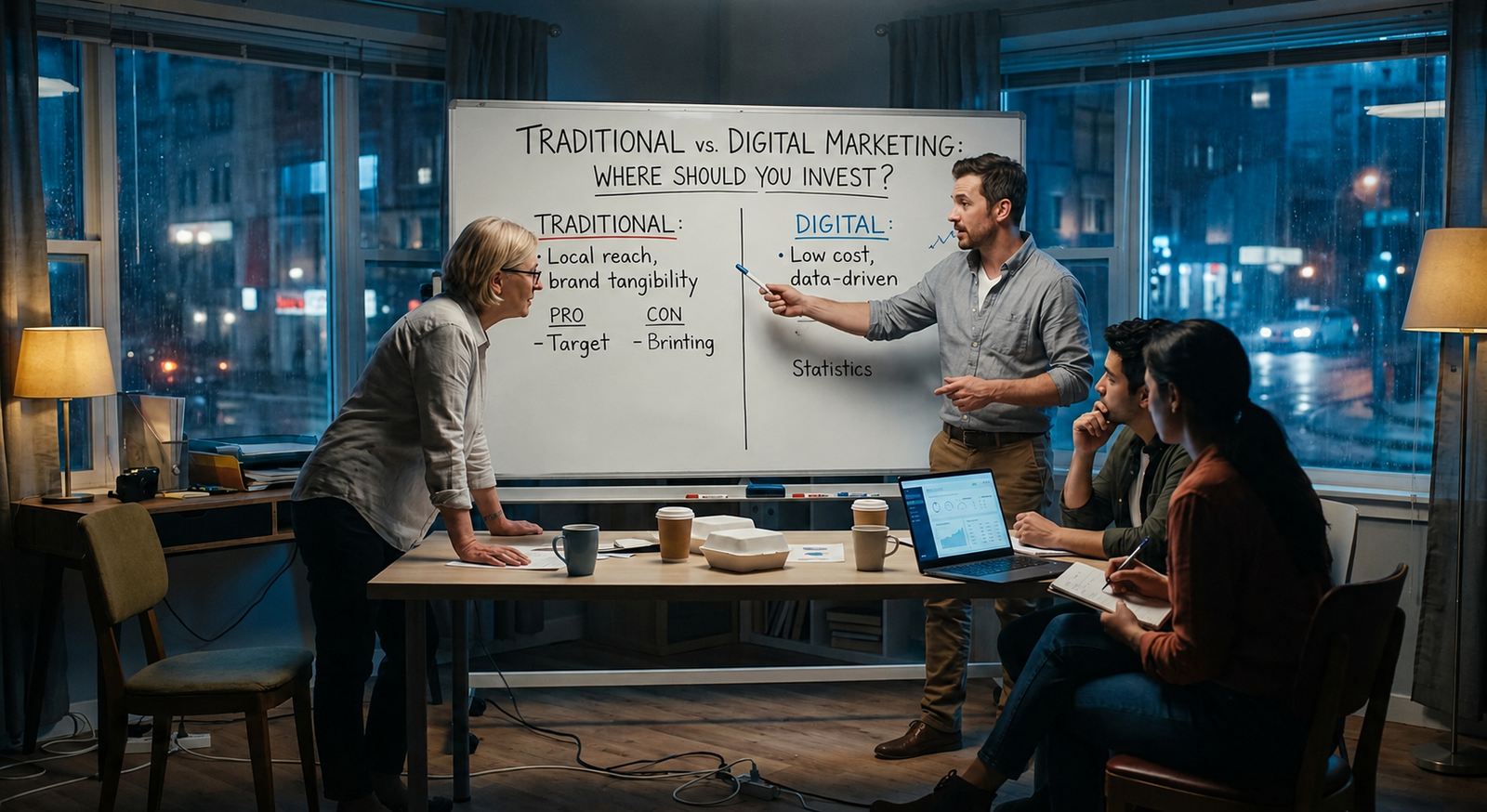
Traditional vs. DigitalMarketing: Where Should You Invest?
If you are building a startup in 2026, one of the earliest and most consequential decisions you will face is where to put your marketing budget. You probably do not have unlimited resources. Every dollar needs to earn its place. And yet, the debate between traditional marketing and digital marketing continues — not because one is obviously better, but because the right answer genuinely depends on who you are, what you are selling, and where your customers spend their attention. This post is not going to tell you to abandon one for the other. Instead, it is going to help you think clearly about what each approach actually delivers, what the landscape looks like right now in 2026, and how startups in particular should be approaching these choices. What Traditional Marketing Still Gets Right Traditional marketing — billboards, print ads, direct mail, radio, TV spots, event sponsorships — has been declared dead many times over the last decade. It has not died. What it has done is narrow its effective use cases considerably. The strongest argument for traditional marketing is trust. There is a psychological weight to a well-placed print ad in an industry publication or a physical mailer that lands on someone’s desk. It signals investment. It signals permanence. For industries where credibility is paramount — legal, financial services, healthcare, enterprise software — showing up in the physical world still carries a signal that a Facebook ad simply cannot replicate. The second argument is reach in specific demographics. If your customers are over 55, if they live in regions where digital penetration is lower, or if your product is inherently local — a restaurant, a retail shop, a regional service — traditional channels can still be cost-effective and surprisingly direct. The honest limitation, however, is measurement. Traditional marketing has always struggled to prove return on investment with any precision. You run a radio campaign for six weeks and sales go up — did the campaign cause that? You cannot know with confidence. For a startup that needs to know exactly what is working and what is not, that ambiguity is expensive. Why Digital Marketing Has Become the Default Starting Point Digital marketing in 2026 is not what it was even three years ago. The channels have matured, the algorithms have become more sophisticated, and the data available to marketers is richer than ever — even as privacy regulations have tightened in meaningful ways across Europe, North America, and Southeast Asia. For startups, the foundational appeal of digital marketing has always been its precision and its scalability. You can start small, test fast, learn constantly, and scale what works. That remains true, and if anything the tools available today make that cycle faster and more accessible than it has ever been. There are four areas where digital marketing tends to deliver the most consistent value for startups. Search Engine Optimization and Content Marketing remain the single most durable long-term investment a startup can make. When you build content that genuinely answers the questions your customers are asking, you earn organic visibility that compounds over time. Unlike paid advertising, the asset does not disappear the moment you stop spending. A well-optimized article or resource that ranks on the first page of Google is working for you every single day without an ongoing cost-per-click. In 2026, with AI-generated content flooding the internet, the premium on authentic, well-researched, deeply useful content has never been higher. Search engines have become increasingly sophisticated at distinguishing between content that exists to rank and content that exists to genuinely inform — and they reward the latter. Social Media Marketing has evolved into something considerably more nuanced than simply posting regularly and hoping for organic reach. Organic reach on most major platforms has compressed significantly over the past few years. What social media does exceptionally well today is community building, brand storytelling, and serving as a trust-verification layer. When a prospective customer hears about your startup and searches for you on LinkedIn or Instagram, what they find is a direct reflection of your credibility. A coherent, active social presence — one that communicates values, expertise, and personality — does serious conversion work even when it is not the original source of discovery. For startups targeting other businesses, LinkedIn in particular has become a remarkably powerful channel for thought leadership and direct relationship building. Paid Advertising through PPC and Meta platforms is where startups can generate immediate traction while other longer-term channels are being built. Google Search campaigns, Meta’s advertising ecosystem across Facebook and Instagram, and increasingly YouTube and connected TV advertising give startups the ability to put an offer in front of exactly the right person at exactly the right moment. The sophistication of audience targeting has improved considerably. In 2026, performance marketing is no longer just about who you can reach — it is about reaching them in the right context, with the right message, at the right stage of their buying journey. Done well, paid advertising delivers measurable, attributable results within days. Done poorly, it burns budget quickly with little to show for it. The difference almost always comes down to strategy, creative quality, and how rigorously the campaigns are managed and optimized. Email Marketing continues to outperform nearly every other digital channel on a return-on-investment basis, and in 2026 that has not changed. What has changed is the sophistication of what high-performing email programs look like. Simply sending a newsletter to a list is not enough. The startups generating real results from email are the ones building segmented, personalized sequences that meet subscribers where they are in the customer journey — from first awareness through to purchase, onboarding, retention, and referral. As third-party cookies have been deprecated and signal loss has made some paid channels harder to optimize, owned audiences — your email list above all — have become a more strategic asset than ever. Every startup should be building one from day one. The Honest Truth About Where Most Startups Go Wrong Most