
The Honest Problem Nobody Talks About Let me tell you something most JavaScript developers don’t want to hear. That beautiful React or Vue application you spent months building? To Google, it often looks like an empty page. Not broken. Not penalized. Just empty. This is the fundamental tension between how modern SPAs work and how search engines crawl the web. Googlebot fetches your URL, receives an HTML file that contains little more than a <div id=”root”></div>, and unless it decides to queue your page for a second JavaScript rendering pass — which it may or may not do promptly — your content simply doesn’t exist in its index. I’ve been doing technical SEO for businesses across Calicut, Kerala, and across industries, and the SPA crawlability problem is one of the most consistently underestimated issues I encounter. Clients come in wondering why their traffic dropped after a site rebuild. Often, the answer is that they migrated from a server-rendered WordPress site to a client-side React application without accounting for what that change does to search visibility. This blog is my attempt to give you a thorough, honest walkthrough of where things stand with SPA SEO in 2026 — and what actually works. Understanding Why SPAs Create SEO Problems Before diving into solutions, it helps to understand exactly what’s going wrong. When Google crawls a traditional HTML website, it fetches a URL and receives a fully formed HTML document. The content is right there. Title tags, headings, paragraphs, links — all present in the raw response. The crawler reads it, indexes it, and moves on. With a single page application, the process is different. The server sends a nearly empty HTML shell. The actual content is assembled by JavaScript running in the browser. From the crawler’s perspective, this means it has to either skip the content or come back later to render it. Google itself documents this two-wave indexing process. Wave one crawls the initial HTML. Wave two — if it happens at all — puts the URL in a rendering queue where Googlebot executes the JavaScript and captures the resulting content. The problem is that this second wave can take days or even weeks. By the time Google sees your content, competitors with traditional HTML pages have already been indexed and ranked. For content-heavy sites, e-commerce platforms, or any business that depends on organic search, this delay is not something you can afford to ignore. Rendering Strategy: The Decision That Changes Everything The most important technical decision you’ll make for SPA SEO is how you handle rendering. Every other optimization you implement is secondary to this one. Server-Side Rendering (SSR) solves the problem at its root. Instead of sending the browser an empty shell and letting JavaScript do all the work, your server executes the JavaScript and sends back fully rendered HTML. When Googlebot requests the page, it receives complete content immediately — no second wave needed. Frameworks like Next.js for React, Nuxt for Vue, and SvelteKit for Svelte make SSR accessible without rewriting your entire application. Next.js in particular has strong documentation on SEO-friendly rendering patterns, and its hybrid approach lets you choose between SSR, static generation, and client-side rendering on a per-page basis. Static Site Generation (SSG) takes a different approach. Rather than rendering pages on demand, your build process generates complete HTML files in advance. These static files load almost instantaneously and are trivially crawlable. For sites with content that doesn’t change on a per-user or per-request basis — marketing pages, blogs, documentation — SSG is often the better choice because it eliminates server processing time entirely. Dynamic Rendering sits between the two. Your application detects whether the visitor is a crawler or a human, and serves pre-rendered HTML to bots while giving users the full JavaScript experience. Tools like Prerender.io handle this detection and caching automatically. Google has clarified that this is not cloaking as long as the content served to bots matches what users see — but it is worth noting that Google considers this a workaround rather than a preferred solution. If you’re building something new, SSR or SSG is the cleaner path. Edge Rendering is gaining momentum in 2026. Platforms like Cloudflare Workers and Vercel Edge Functions let you run rendering logic at servers geographically close to your users, dramatically cutting time to first byte. For global audiences, this matters both for performance and for crawl efficiency. My recommendation depends on the project. For e-commerce or anything with real-time pricing and inventory, SSR is almost always the right call. For marketing sites and blogs, SSG wins. For teams that can’t afford to refactor immediately, dynamic rendering buys time while a proper SSR migration is planned. URL Structure and Hash Routing This is the most straightforward fix on this list, and yet I still see it regularly in audits. If your SPA uses hash-based routing — URLs that look like example.com/#/about or example.com/#!/products/123 — you have a serious indexability problem. Hash fragments are never sent to the server. They exist purely in the browser’s address bar. From a server’s perspective, every one of those URLs looks identical. From a search engine’s perspective, they are largely invisible. Google has documented its limited ability to crawl hash URLs, but the behavior is inconsistent enough that you should not rely on it. The fix is to switch to HTML5 pushState routing, which produces clean URLs like example.com/about and example.com/products/123. React Router, Vue Router, and Angular’s Router all support this out of the box. The server needs to be configured to serve the SPA shell for any route, with a fallback that handles 404s gracefully — but this is a one-time configuration change, not an ongoing burden. If your site has been live with hash routing and you’re migrating, set up proper 301 redirects from the old hash URLs to the new clean URLs. Ahrefs has a good breakdown of technical redirect best practices if you’re going through that process. Dynamic Metadata for Every Route One of the

Why Your Business Needs a Branding Partner, Not Just a Logo Designer — And How to Find the Right One in 2026
There is a version of your business that people trust before they even read a word of your website. A version that makes people feel something the moment they come across your name, your colors, or your content online. A version that does not have to fight for attention because it already has a clear identity and a reputation that does the talking. That version is not accidental. It is built. And in 2026, building that kind of brand requires more than a nice logo and a clean website. It requires a strategic, consistent, and deeply human approach — exactly what a good branding agency brings to the table. The Real Problem Most Businesses Face Most businesses struggle not because their product is bad, but because the world outside never quite sees it clearly. The offering is solid, the team is hardworking, but the message gets lost. The audience is not connecting. Competitors who are doing less are somehow getting more attention. This is a branding problem — and it is far more common than most business owners want to admit. When a business has weak branding, a few things happen consistently. First, it becomes invisible in a crowded market. Second, it attracts the wrong clients — or struggles to attract any at all. Third, it is forced to compete on price because it has not given people a better reason to choose it. And fourth, it finds scaling nearly impossible because there is no coherent story to anchor the growth. A branding agency addresses all of this at the root level. What a Branding Agency Actually Does People often think of branding as a visual exercise — colors, fonts, logos. That is a part of it, but only the surface layer. What a branding agency really does is help a business answer the questions that customers are silently asking: Who are you? Why does this matter? Can I trust you? Why you and not someone else? The process starts with deep discovery work — understanding the business, its market, its competitors, its customers, and what the founders actually stand for. From that foundation, a brand strategy is built. This includes the brand’s positioning, its tone of voice, its core message, and the emotional territory it owns in the minds of its audience. Then comes the visual identity — developed not from aesthetic preference, but from strategic thinking. Every design choice is rooted in what the brand is trying to communicate. After that comes implementation across every touchpoint: the website, the content, the social presence, the sales materials, and the customer experience itself. When done well, the result is a brand that feels cohesive, credible, and compelling across every channel — one that attracts the right people and makes them want to stay. How Branding Builds Trust Before the Conversation Starts Trust is the currency of modern business. It takes time to earn and almost no time to lose. And in 2026, customers are more skeptical than ever — they have access to more information, more alternatives, and more ways to verify who they are dealing with before they ever make contact. This means trust can no longer be built solely through conversation or reputation over time. It has to be embedded in the brand itself. A professional, consistent, and well-crafted brand signals competence before you say a word. It tells people that you take your work seriously, that you have thought about your audience, and that you show up the same way everywhere. That consistency is one of the most powerful trust signals that exists — more powerful, in many ways, than even positive reviews. Research from Edelman’s Trust Barometer has consistently shown that brand credibility significantly influences purchase decisions, particularly for first-time buyers who have no prior relationship with the business. In the absence of personal experience, people trust the signal that a brand sends — and a polished, clear brand sends a strong one. Branding and SEO Are Not Separate Conversations This is something that gets overlooked often, and it matters enormously in 2026. A strong brand directly supports your search engine performance. When people recognize and search for your brand by name, when your content earns organic backlinks because it is genuinely useful, when your website copy is clear and resonant — all of this sends trust signals to search engines as well as to humans. Working with someone who understands both sides of this equation — the brand story and the search strategy — makes a significant difference in how fast a business grows online. If you are looking for the best SEO expert in Calicut who also understands brand positioning, the edge comes from integrating these two disciplines rather than treating them as separate services. Google’s own Search Quality Rater Guidelines place enormous weight on E-E-A-T — Experience, Expertise, Authoritativeness, and Trustworthiness. A well-developed brand naturally demonstrates all four. Your branding and your SEO strategy should be built together, not after one another. The Businesses That Scale Are the Ones With a Clear Identity Scaling a business without a clear brand identity is like trying to pour water into a container with no shape. The growth does not hold. When a business has a strong brand, scaling becomes significantly easier — and not just in theory. Hiring becomes easier because you attract people who believe in what you stand for. Partnerships open up because people know who they are dealing with. Referrals increase because clients can describe you clearly. And content marketing starts compounding because there is a coherent voice and perspective behind it. HubSpot’s 2025 State of Marketing Report noted that businesses with consistent brand presentation across platforms saw revenue increases of up to 20 percent. Consistency is not a design preference — it is a growth strategy. A branding agency does not just create assets. It creates the systems and guidelines that allow a business to maintain its identity as it grows, regardless of who is creating content or managing channels. Standing

Why Most Businesses Pick the Wrong Logo (And How to Get Yours Right in 2026)
Your logo is not your brand. But it is the first thing people see, the last thing they remember, and often the only thing standing between a stranger clicking on your business or scrolling right past it. That is a lot of pressure for a small graphic. The problem is that most business owners approach logo design the wrong way. They either spend too much money chasing trends that fade in two years, or they settle for something cheap that never actually represents who they are. Neither approach works. In 2026, with more businesses competing for attention online than ever before, your logo needs to do a very specific job and do it well. This guide will help you understand what that job is and how to make a logo decision you will not regret. What a Logo Is Actually Supposed to Do Before you start browsing color palettes and font combinations, you need to be honest about what you are trying to accomplish. A logo has one primary function: recognition. That is it. It should make people recognize you instantly in any context, whether it is on a business card, a website header, a social media profile, or a billboard. Everything else, the meaning, the story, the emotion behind your brand, comes from the totality of how you show up across every channel. Your logo is just the visual anchor for all of that. When you understand this, a lot of the overthinking disappears. You are not designing a piece of art. You are designing a mark that needs to be clear, memorable, and versatile. The Common Mistakes That Lead to a Bad Logo Designing for yourself instead of your audience. This is the most common error. Business owners choose colors they personally love, symbols that feel meaningful to them, and typography that appeals to their own taste. None of that matters if it does not resonate with the people you are trying to reach. A logo is communication. The recipient, not the sender, determines whether communication works. Following design trends too closely. In 2024 and 2025, there was a strong wave of gradient logos and ultra-thin serif fonts. By now, many of those already look dated. Trendy logos have a shelf life. Classic, well-considered logos can last twenty or thirty years without needing a major overhaul. Think about the logos you have seen for decades and still recognize instantly. They were not built on trends. Overcomplicating it. The instinct to add more, more detail, more layers, more meaning, almost always backfires. Complicated logos do not scale well. They break down at small sizes, they become hard to use on dark backgrounds, and they are genuinely harder to remember. Simplicity is not laziness. It is discipline. Ignoring how it looks in different contexts. Your logo needs to work in black and white. It needs to work at the size of a favicon, which is 16 by 16 pixels. It needs to work on a white background, a dark background, and on a t-shirt. If you only see it mocked up on a MacBook screen in a polished presentation, you are not seeing the real test. Skipping the strategy and going straight to visuals. Design is not just an aesthetic decision. It is a strategic one. Before anyone touches a design tool, you should have clear answers to questions about your target audience, your brand personality, your competitive landscape, and what you want people to feel when they see your name. Without this foundation, you are guessing. How to Think About Color Color is probably the most emotionally loaded decision in your logo. Research published by sources like the Journal of Business Research consistently shows that color accounts for a significant portion of first impressions. But the mistake people make is treating color psychology like a rigid formula. Blue does not automatically mean trust. Red does not automatically mean urgency. Context matters enormously. What you should actually think about is differentiation within your category. Look at the colors your competitors are using. If every business in your space uses blue, there might be a real opportunity in using something else. If warm earth tones dominate your industry, going clean and minimal with black and white might make you stand out. You also need to think about your ideal customer. A luxury brand and a children’s toy company both use bold colors, but for completely different reasons and to completely different effect. Who are you talking to, and what visual language do they already associate with quality in your space? Finally, consider practicality. Some colors look beautiful on screen but are expensive or difficult to reproduce in print. If you are going to be printing a lot of physical materials, that is worth knowing before you fall in love with a particular shade. How to Think About Typography Typography is where a lot of logos either earn credibility or lose it. The font you choose carries a personality before anyone reads a single word. Serif fonts generally feel established, authoritative, and traditional. Sans-serif fonts feel clean, modern, and accessible. Script fonts can feel personal and creative, but they are often harder to read at small sizes and can come across as informal in ways that hurt certain brands. One practical rule: avoid overly decorative fonts unless you have a very specific reason for using them. The readability test is simple. If someone has to slow down to read your business name, the font is working against you. Custom typography, where a designer actually draws letterforms specific to your brand, is expensive but worth considering for larger businesses. For most small and medium businesses, a carefully chosen and properly customized commercial typeface is the right answer. For a useful reference on typography principles applied to identity design, the team at Google Fonts has put together thoughtful guidance on pairing and readability that is worth reading even if you are not a designer. The Shape and Symbol Question Not every logo needs

Why Original Content Is Now the Cornerstone of SEO in 2026
There was a time when you could get away with rewriting a few paragraphs from a competitor’s page, slap on a new title, and watch it rank. Those days are gone. The way search engines evaluate content has matured dramatically, and what worked in 2019 or even 2022 will actively hurt you today. If you are running a business online and wondering why your pages keep slipping in rankings despite regular publishing, the answer might be simpler — and more uncomfortable — than you think: duplicate or low-quality content. This is not just an SEO problem. It is a trust problem. And in 2026, Google’s systems have gotten precise enough to detect it. The Shift in How Google Reads Content Google’s Helpful Content System, which has gone through several major updates since its launch, now evaluates content on a fundamentally different axis than before. It no longer just asks “does this page contain the keyword?” — it asks “did a real human with genuine expertise write this, and does it actually help someone?” That shift matters enormously when you think about plagiarism. Plagiarised content fails both tests. It does not come from original expertise, and it does not add anything new to what already exists on the web. The algorithm has grown capable of detecting not just exact matches, but structural similarities, idea-level copying, and even paraphrasing that follows the same logical sequence as an existing source. Sites that were once competitive with this kind of content are now seeing sustained ranking drops they cannot explain with just a technical audit. What Plagiarism Actually Looks Like in 2026 A lot of website owners assume plagiarism means copy-pasting an article word for word. That is only the most obvious version. In practice, it shows up in several quieter ways: Paraphrased but structurally identical content. You take an article, swap synonyms, rearrange a few sentences, and call it original. Search engines have seen enough of this to model it at scale. It reads as duplicate, even if no sentence matches exactly. AI-generated content published without human editing. This became a massive issue through 2024 and 2025. Bulk-generated AI content, especially from models prompted to write about the same topics with the same instructions, often converges on similar phrasing, structure, and examples. The result is hundreds of nearly identical pages competing for the same keyword — none of them ranking because none of them add genuine value. Scraped content with minor edits. Some sites still run automated systems that pull content from news feeds, competitor blogs, or product databases and publish them with minor modifications. This is one of the fastest ways to earn a manual penalty from Google. Internal duplicate content. This one surprises people. If you have the same product description across multiple pages, or the same blog content appearing under different URL paths, you are competing against yourself and giving Google a reason to ignore both. Why This Matters More Than Ever Right Now The content ecosystem is noisier than it has ever been. The rise of generative AI tools has meant that publishing volume has skyrocketed across every industry. At the same time, search engine result pages have gotten more selective. Featured snippets, AI Overviews, and zero-click results now take up prime space. To earn a spot anywhere meaningful, your content has to genuinely stand out. In that environment, original, well-researched, human-written content is not just a best practice — it is a competitive advantage. Every piece of plagiarised or thin content on your site is dragging down the authority of your entire domain. There is also the legal dimension, which many businesses overlook. Using someone else’s content without attribution or permission is copyright infringement. For a business that depends on its online reputation, a DMCA notice or a lawsuit is a real possibility, not just a theoretical risk. How Plagiarism Checking Fits Into a Real SEO Workflow Running content through a plagiarism checker is not the end of the process — it is the beginning. Here is how a serious content quality workflow looks in 2026: Before publishing: Every piece of content, whether written by a human, assisted by AI, or sourced from a freelancer, should run through a plagiarism detection tool. Copyscape, Grammarly Business, and Originality.ai are commonly used for this. If the similarity score is above 10 to 15 percent, the content needs revision. During a site audit: If you are auditing an existing website, especially one that has had multiple contributors over the years, a bulk plagiarism scan is essential. You may find older pages that were fine in 2018 but are now creating problems across the entire domain. After using AI writing tools: AI content should always be treated as a first draft, not a final product. A human editor needs to add original insight, real examples, updated data, and a voice that reflects actual expertise. Running it through a plagiarism checker afterward confirms whether the AI borrowed too heavily from existing sources in its training data. When onboarding new writers: Establishing plagiarism checking as a standard part of your editorial process protects you from problems you might never detect otherwise. Writers working under deadline pressure sometimes take shortcuts, and a systematic check catches that before it goes live. The Connection Between Content Quality and Local SEO If you are a business based in a specific location — say, a service provider or a professional working out of Kerala — the content quality issue hits twice as hard. Local SEO is built on trust signals, and those signals compound over time. A local business that consistently publishes original, useful content relevant to its audience builds domain authority that translates directly into local rankings. On the other hand, a local business with a site full of copied or thin content sends exactly the opposite signal. Google’s local ranking algorithm weighs expertise, authority, and trustworthiness. Plagiarised content undermines all three. For businesses looking to rank in local searches, the gap between a site with original

Should You Hire a Web Agency or a Freelancer in 2026? An Honest Answer
If you’ve been sitting on the fence trying to decide between hiring a web development company and working with a freelancer, you’re not alone. This is one of the most common questions I hear from business owners, startups, and local entrepreneurs — especially here in Calicut. And honestly, most of the advice out there doesn’t actually help, because it’s written by agencies trying to sell you a retainer or freelancers trying to win your project. So let me give you a straight answer, one that doesn’t dodge the hard parts. The Decision Matters More Than You Think Your website in 2026 is not just a digital brochure. It’s the first place people go when they hear your name. It affects how Google ranks you. It determines whether a visitor stays for 10 seconds or becomes a paying customer. So whether you choose an agency or a freelancer isn’t just a budget decision — it’s a business decision. Let’s break it down the way it actually works. What a Web Development Agency Brings to the Table An agency typically offers a team. You get a project manager, a designer, a developer, maybe an SEO person, and someone who handles client communication. For large, complex projects — like an enterprise-level e-commerce platform or a SaaS product with multiple user roles — that structure can be genuinely useful. Agencies also tend to have documented processes. They’ve built hundreds of websites, and they have templates, workflows, and internal standards that prevent certain mistakes. If you have a long-running project that needs continuous maintenance and iteration, working with an agency can feel more stable because there’s a system behind it. That said, you pay for all of this. Agency pricing in 2026 reflects not just your work, but their office rent, their team salaries, their project managers, and their sales team. A lot of what you’re paying for never actually touches your project. There’s also the matter of personal attention. Agencies take on multiple clients at once. When you send an email, it often goes through a ticketing system before it reaches anyone who can actually help you. If you’re a mid-sized local business, you might find yourself a small fish in a big pond — your project handed off to a junior developer while the senior team works on a bigger account. According to HubSpot’s 2025 Marketing Report, 64% of small businesses say poor communication was their biggest frustration when working with agencies. That number hasn’t gotten better. What Working With a Freelancer Actually Looks Like A freelancer, at its best, is one person who owns your project from start to finish. There’s no handoff between departments, no Chinese whispers between a salesperson and a developer, and no account manager acting as a translator for your actual needs. When you hire the right freelancer, you’re talking directly to the person building your site. You get faster feedback loops, quicker revisions, and someone who genuinely understands your business because they had to — there was no team to delegate that understanding to. Cost is also meaningfully lower. Not because freelancers are less skilled — many senior freelancers have more experience than agency team leads — but because you’re not paying for overhead. The real concern people have with freelancers is reliability. What if they disappear? What if the quality is inconsistent? Those are fair concerns, and they’re real risks if you hire without doing your homework. The answer is to work with someone who has a track record, clear communication habits, and a portfolio that actually speaks to your use case. Where Things Actually Go Wrong The biggest mistakes I see businesses make aren’t about choosing the wrong type of provider. They’re about mismatching the scope of the work with the type of provider they chose. A startup building a five-page portfolio site doesn’t need an agency. A company launching a marketplace with 40,000 product listings probably shouldn’t rely on a solo developer working from a coffee shop without a backup plan. Before you make any decision, ask yourself: how complex is this project, what’s the timeline, how much post-launch support will you need, and what’s your budget not just for build but for maintenance? If you’re running a local business and you need a fast, well-built website that ranks on Google, converts visitors, and doesn’t cost you six months of revenue — a skilled freelancer is almost always the better call. The SEO Question Nobody Asks Upfront Here’s something I want to address specifically, because I’ve seen it cause real problems. A lot of businesses get a beautiful website built and then discover it doesn’t rank for anything. The design team did their job, but nobody thought about how Google would read the pages, whether the site loads fast on mobile, or whether the content is structured in a way that search engines actually reward. SEO can’t be bolted on after a site is built. It has to be part of how the site is built. The URL structures, the heading hierarchy, the page speed, the schema markup, the internal linking — all of it matters, and all of it is easier to do right the first time than to fix later. This is why, when people search for the best SEO expert in Calicut, what they’re really looking for isn’t just someone who can run a keyword report — they’re looking for someone who understands that SEO and web development aren’t separate disciplines. They feed each other. A site built with SEO in mind from the ground up will always outperform one where SEO was an afterthought. For a deeper understanding of how modern SEO integrates with web architecture, Google’s own Search Central documentation is still the most reliable source in 2026 — updated regularly and more honest than most agency blogs. What I Do and Why It Matters for Your Decision I work as a freelance web developer, SEO specialist, and UI/UX designer — which means I’m not a generalist who
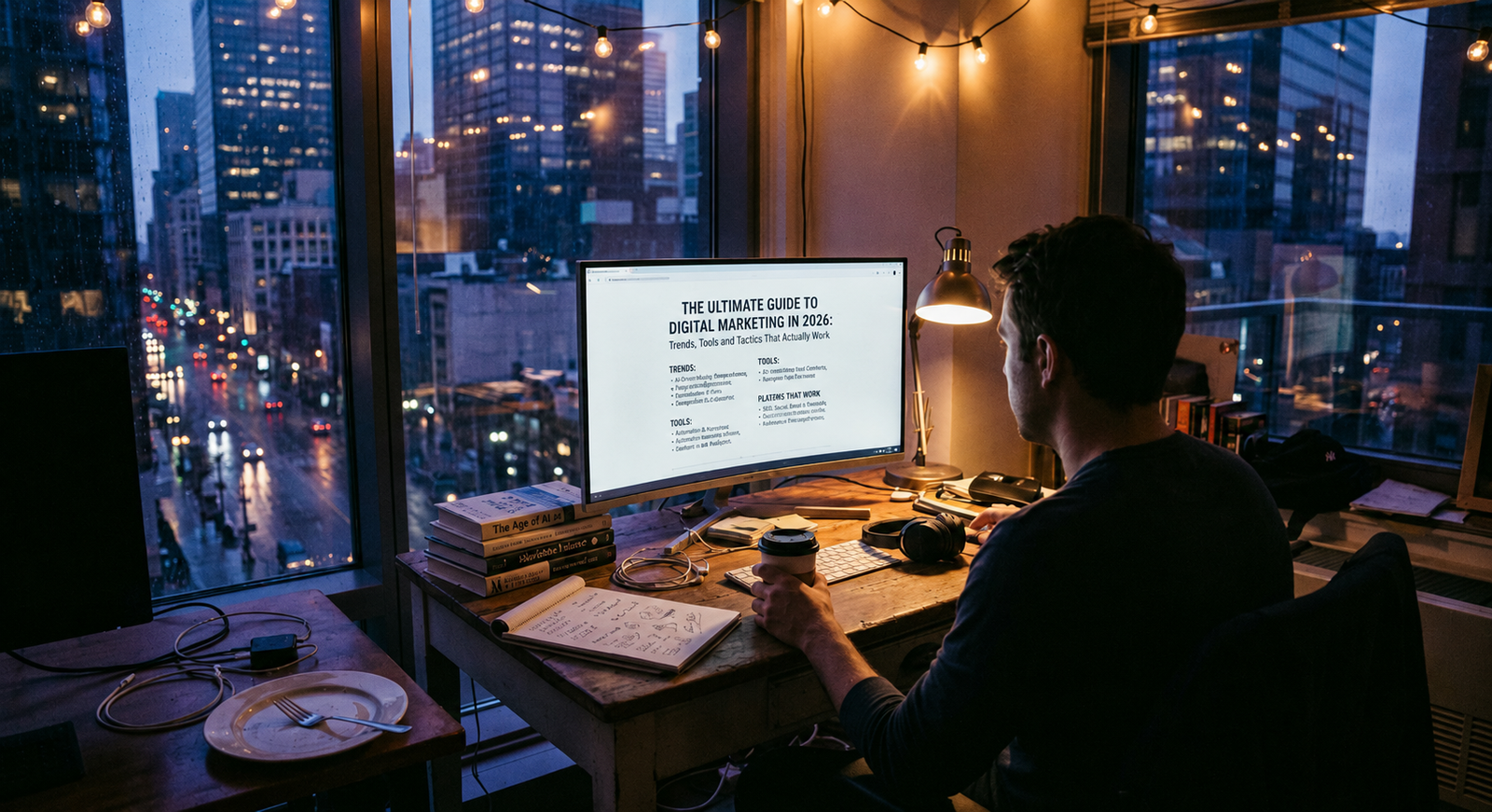
The Ultimate Guide to Digital Marketing in 2026 – Trends, Tools & Tactics
Digital marketing in 2026 looks nothing like it did just two or three years ago. The rules have shifted, the tools have matured, and the expectations of consumers have grown sharper than ever. Brands that are still treating their digital presence as a series of disconnected campaigns are already falling behind. The ones gaining ground are those treating digital marketing as an integrated discipline built on data, genuine content, and a deep understanding of how people actually search, scroll, and buy. This guide covers everything you need to know to compete in 2026 — from the trends shaping the landscape to the specific tools and tactics that are moving the needle. Whether you are running marketing in-house or working with an agency, this is your operating manual for the year ahead. The State of Digital Marketing in 2026 The numbers tell a clear story. Global digital advertising spend has crossed $740 billion in 2026, representing a year-over-year increase of more than 11 percent and now accounting for 73 percent of all global media spend. Over 6.12 billion people are online worldwide — nearly 74 percent of the world’s population — and 5.79 billion of them are active on social media in some form. Mobile devices account for more than half of all web traffic globally. What this means for marketers is that the audience has never been larger, but the competition for attention has never been fiercer. Getting in front of the right person at the right moment requires a level of precision, creativity, and consistency that casual or reactive marketing simply cannot deliver. According to HubSpot’s 2026 Marketing Statistics, brands that use integrated, multi-channel marketing strategies see significantly higher engagement and conversion rates compared to those relying on a single channel. The era of picking one platform and hoping for the best is over. Trend One: AI Is Now the Foundation, Not the Feature If 2024 was the year marketers experimented with AI, 2026 is the year they cannot function without it. Only 4.6 percent of marketers report not using AI in their workflows. The majority are using it for content creation, email optimization, audience segmentation, lead scoring, and campaign analysis. According to data published by EntrepreneursHQ, up to 85 percent of marketing tasks can now be automated through AI-powered tools. But here is the nuance that separates good marketing from mediocre output: AI is a production engine, not a creative brain. The brands winning in 2026 are those using AI to scale and accelerate their human thinking — not replace it. They are feeding AI with real data, original perspectives, and genuine brand voice, then using it to produce more efficiently. Readers and search algorithms alike can detect content that has been generated without thought, and they penalize it accordingly. The tools to know right now include Jasper for AI-assisted writing, Surfer SEO for content optimization, Semrush for competitive intelligence, and Salesforce Marketing Cloud for AI-powered customer journey automation. These are not novelties. They are the new standard. Trend Two: Search Has Changed Fundamentally Google’s landscape in 2026 is dramatically different from what it was even eighteen months ago. AI Overviews now appear in roughly 5 to 12 percent of all searches, pulling summarized answers directly from multiple sources and displaying them at the top of the results page. This has introduced a new layer of competition — one where ranking in the top three organic results no longer guarantees significant traffic. According to Search Engine Land’s analysis of content strategy in 2026, Google’s March 2026 core update placed a heavy emphasis on Information Gain — a ranking signal that rewards content adding genuinely new knowledge to what already exists in the search results. If your article is saying what fifty other articles are already saying, it will not rank. If it offers original research, proprietary data, first-hand testing, or analysis grounded in real expertise, it stands a strong chance. This is a meaningful shift for content marketers. The volume game is over. Producing fifty thin blog posts a month no longer works. Producing ten thoroughly researched, expertly written pieces that genuinely help people understand something they could not easily find elsewhere — that is what earns authority in 2026. Additionally, search visibility now extends well beyond Google. LLMs like ChatGPT, Claude, and Perplexity are increasingly the first stop for research queries. These systems pull information from sources that have established credibility across the web — including Reddit threads, LinkedIn articles, industry forums, and high-authority publications. If your brand is not showing up in those spaces, you are invisible to a growing segment of the market. Trend Three: Short-Form Video Is the Fastest Path to Attention Ninety-one percent of businesses now use video as a marketing tool, and 82 percent say it has directly increased sales. Short-form video — content under sixty seconds on TikTok, Instagram Reels, and YouTube Shorts — has become the dominant format for brand awareness and top-of-funnel engagement in 2026. What makes short-form video work is not production quality. It is the hook. According to DataReportal’s Digital 2026 Global Overview, the average person makes a scroll-or-stay decision within two seconds. That means your first frame, your first line, and your first visual all have to earn the viewer’s attention before they swipe away. The best-performing short-form content in 2026 follows a clear structure: open with a sharp, specific problem or claim, deliver a quick and satisfying resolution, and end with a clear signal of where to go next. UGC-style delivery — shot on a phone, featuring a real person speaking naturally — consistently outperforms polished studio content because it feels credible and human. For brands investing in social media marketing, the practical implication is to test messaging in short-form video before spending on longer content or paid distribution. If a concept does not generate engagement in a fifteen-second format, it is unlikely to perform well anywhere else. Trend Four: Paid Advertising Is Smarter but Requires Smarter Management The PPC landscape in 2026 has

Mobile Marketing: ReachingOn-the-Go Customers
Something changed permanently in the way people move through their day. They wake up to a notification before they leave the bedroom, check a message while waiting for coffee, scroll through an ad on the train, and tap a purchase button during lunch. The phone is not a device they pick up when convenient — it is an extension of how they experience the world. If your business is not present in that experience, you are not invisible. You are simply absent. In 2026, mobile devices account for 60.7 percent of all global internet traffic, and mobile commerce has crossed the four-and-a-half-trillion-dollar threshold. These are not future projections — they are the conditions your customers already live inside. The question for any brand is not whether to invest in mobile marketing, but whether it is doing so with the precision and strategy the medium demands. This guide walks through what effective mobile marketing looks like right now, why the conventional approaches no longer suffice, and how four interconnected strategies — SMS and WhatsApp marketing, mobile app marketing, targeted mobile ad campaigns, and push notification strategy — can work together to build genuine relationships with customers who are always on the move. The Mobile-First Reality Is No Longer a Trend Marketers have been told for a decade that mobile is the future. That framing has always been misleading, because mobile stopped being the future a long time ago. It is the present, and for many brands, it is the past they failed to prepare for. Consider what the data reveals in 2026. Mobile devices now originate 75 percent of all e-commerce traffic. Social media sessions happen on mobile 91 percent of the time. The average person unlocks their phone 96 times a day. These figures do not describe a niche audience or a generational preference — they describe the normal behavior of adults across virtually every demographic and geography. According to HubSpot’s 2026 Marketing Statistics Report, 94 percent of marketers now plan to integrate AI into their mobile content creation workflows — a signal that the channel has matured from experimentation into operational infrastructure. The brands winning on mobile are not the ones with the biggest budgets. They are the ones that understand how mobile behavior actually works. What makes mobile behavior distinct is its context. A person on their phone is usually doing something else simultaneously — commuting, waiting, resting. The window of attention is narrow but genuine. Getting that moment right means delivering a message that feels relevant, human, and worth the interruption. Getting it wrong means a blocked number, an uninstalled app, or a turned-off notification. “The brands winning on mobile are not the ones with the biggest budgets. They are the ones that understand how mobile behavior actually works.” SMS and WhatsApp Marketing: Direct, Personal, and Impossible to Ignore There is a reason SMS has survived every new channel that has launched around it. Nothing else delivers a message this directly into someone’s hand with this kind of reliability. In 2026, SMS carries a 98 percent open rate, with most messages read within three minutes of delivery. That is a level of attention no email newsletter or social media post can approach. What we do in this space goes far beyond blasting promotions to a contact list. Effective SMS marketing is built on segmentation, timing, and tone. A well-written text message feels personal — not because it is pretending to be from a friend, but because it is relevant to exactly where that customer is in their journey. A reminder for an abandoned cart. A restock alert for a product they viewed. A loyalty reward delivered at the moment it will actually be used. The ROI data for SMS is extraordinary by any standard. E-commerce brands are currently seeing returns of $71 for every dollar spent on text campaigns, according to 2026 industry benchmarks. The U.S. SMS marketing market has grown to $12.6 billion and is expanding at 20.3 percent annually — growth rates that reflect not just adoption, but confidence in the channel’s performance. WhatsApp adds an important dimension to this picture. With over two billion active users globally, WhatsApp is not just a messaging app — it is, in many markets, the primary channel through which people communicate. Brands using WhatsApp Business for post-purchase follow-ups are seeing repeat purchases increase between 20 and 35 percent. Companies deploying WhatsApp-based AI chat flows have recorded lead generation increases of over 600 percent in some categories. Our SMS and WhatsApp marketing capability covers the full lifecycle: strategy and audience segmentation, message writing and compliance, campaign sequencing, A/B testing, and performance reporting. We build campaigns that feel like conversations, not broadcasts. For businesses ready to get serious about direct mobile communication, Chatarmin’s 2026 SMS vs. WhatsApp comparison provides a useful benchmark for understanding when to use each channel. Mobile Ad Campaigns: Precision Over Volume Global mobile ad spend surpassed $430 billion in 2026, with mobile now absorbing 74 percent of total digital advertising investment worldwide. The scale of this market can obscure a harder truth: most mobile advertising is wasted. It reaches the wrong person at the wrong moment on the wrong platform, and it gets scrolled past without a second thought. The reason most mobile ad campaigns underperform is not the medium — it is the approach. Brands pour budget into broad targeting, use creative designed for desktop, and measure success by impressions rather than actions. The result is spending without signal, reach without meaning. What effective mobile ad campaigns look like in 2026 is fundamentally different. The three dominant platforms — Google, Meta, and TikTok — now capture 67 percent of all mobile ad dollars, but that concentration does not mean every brand should be on all three simultaneously. The right platform depends on the product, the audience, and the creative format that will genuinely stop someone mid-scroll. Our mobile ad campaign work starts with audience architecture. Who is the customer, what are they doing when

Content Marketing: CreatingEngaging Content That Converts
There is a version of content marketing that most people recognize — the blog posts that exist purely for keyword stuffing, the social media captions that feel like they were written by a machine at 2 a.m., the email newsletters that arrive every Tuesday saying absolutely nothing. Then there is the version that actually works. The gap between those two versions is not a matter of budget or team size. It is a matter of intention, craft, and a genuine understanding of who you are writing for and why. In 2026, that gap has never been more consequential. The internet is saturated with content. Algorithms are smarter. Audiences are more selective. Attention is harder to earn than ever before. And yet — the brands and professionals who invest in genuinely useful, well-crafted content are seeing returns that paid advertising simply cannot match. According to the Content Marketing Institute’s 2026 B2B Report, 73% of the highest-performing marketing teams credit documented content strategy as a primary driver of their results. This is not a coincidence. It is the outcome of treating content as a discipline rather than a checkbox. Why Most Content Fails to Convert Before talking about what works, it is worth being honest about what does not. Most content fails at the conversion stage not because it is poorly written, but because it was created without a clear understanding of where it sits in the buyer’s journey. A first-touch blog post designed to generate awareness should not read like a sales pitch. A product comparison page should not bury the key differentiators under three paragraphs of generic industry background. An email nurture sequence should not send the same message to a cold lead and a warm prospect who already downloaded your case study. The problem is usually structural. Content gets created in isolation — one team writes the blogs, another manages email, someone else handles social — and none of it is aligned to a coherent narrative that moves a reader from curiosity to confidence to conversion. According to Semrush’s State of Content Marketing 2026, 61% of marketers say their biggest challenge is creating content that actually drives revenue. The answer is almost always better alignment, not more volume. The Foundation: Understanding Your Audience Beyond Demographics Demographics tell you who your audience is. Psychographics tell you how they think. Neither one tells you what they need to hear right now, at this specific moment in their decision-making process. The most effective content strategies in 2026 are built on something called intent mapping — the practice of understanding not just what your audience searches for, but what they are trying to accomplish when they search for it. A marketing professional searching “content calendar template” is not in the same mental space as one searching “why is my content not converting.” Both are relevant queries, but they require completely different responses. Building this map takes time and genuine curiosity. It means reading customer support tickets, sitting in on sales calls, studying the language your audience uses in community forums and LinkedIn comment sections. It means taking those raw signals and turning them into content that feels like it was written specifically for one person — because in the best cases, it practically was. SEO Writing: Visibility That Does Not Compromise Quality Search engine optimization and quality writing are not in conflict. They never were. The idea that you have to choose between writing for people and writing for search engines was always a false dichotomy — one that was convenient for those selling shortcuts but never grounded in how good content actually performs over time. In 2026, Google’s Search Generative Experience has fundamentally changed how content surfaces. AI-generated overviews now appear at the top of many search results, which means the stakes for ranking in traditional organic positions have shifted. What performs is content with genuine depth, original insight, and clear expertise. Thin, formulaic posts that hit keywords but say nothing new are increasingly invisible. Effective SEO writing today means: Building topical authority over time by covering subjects comprehensively, not just chasing high-volume keywords. A brand that has written ten genuinely useful pieces on email segmentation is more likely to rank than one that has written one post that mentions segmentation fifteen times. Structuring content so that it answers the primary question quickly, then provides the depth that keeps readers engaged and signals relevance to search engines. Featured snippets and AI overview citations tend to come from content that is both accessible and authoritative. Earning backlinks organically by creating resources that practitioners genuinely want to reference. Ahrefs’ Link Building Research continues to confirm that editorial backlinks from relevant, high-authority domains have a compounding effect on domain authority that no paid link scheme can replicate sustainably. This is work I do with a focus on both technical precision and genuine readability. Every piece of SEO content I produce is built to rank without sacrificing the human intelligence that makes it worth reading in the first place. Social Media Content: Built for Conversation, Not Just Distribution Social media has matured. The era of posting a link and waiting for traffic is over. The platforms that drive real business results in 2026 — LinkedIn for B2B, Instagram and TikTok for consumer brands, X for real-time relevance — all reward native content that generates conversation, not content that uses the platform as a bus stop on the way somewhere else. What this means practically is that social content needs its own strategy, its own voice, and its own goals. A blog post can be repurposed into a LinkedIn carousel, but the carousel should not just be slides of the blog. It should be a standalone piece of content that makes a specific argument, tells a specific story, or asks a specific question — and it should do it in a way that invites response. The social content that drives conversion in 2026 tends to share a few qualities. It leads with a perspective rather than

Social Media Marketing: Best Practices for 2026
Social media in 2026 is not what it was two years ago. The platforms have shifted. The algorithms have been rebuilt. The audiences have grown more selective, more skeptical, and frankly, more tired of content that talks at them instead of with them. According to Sprout Social’s 2026 Index, over 74% of consumers now say they are more likely to buy from a brand they feel a genuine connection with on social media. If your strategy has not been updated to reflect that reality, the gap between where you are and where you need to be is already costing you. This is not a post about chasing trends or overhauling everything overnight. It is about understanding what is actually working right now, why it works, and how to put it into practice in a way that makes sense for your brand. Whether you are a business owner managing your own presence or working with a team to scale, these practices will give you a clear, grounded foundation for the rest of the year. Authenticity Has Become Non-Negotiable For years, brands were told to be authentic. Most nodded, then went back to producing polished content that looked like everyone else. In 2026, audiences are no longer just noticing the difference between real and manufactured. They are actively choosing to engage with brands that feel human, and scrolling past everything that does not. This shift accelerated as AI-generated content flooded every platform. When everything can be produced instantly and at scale, the content that stands out is the kind that could only come from a specific person, a specific moment, or a specific perspective. HubSpot’s State of Marketing Report confirms that behind-the-scenes content and unscripted brand moments consistently generate higher engagement rates than heavily produced campaigns. What this means practically is that your content strategy needs room for spontaneity alongside structure. Not every post needs to be perfect. Some of your best-performing content this year will probably be the things that felt the least produced. Build a content mix that balances your polished brand assets with real, timely moments that remind people there are actual humans behind your account. Short-Form Video Has Matured, and So Must Your Approach Short-form video is no longer an experiment or an emerging format. It is the default way people consume content on nearly every major platform. Reels, TikTok, YouTube Shorts, and their equivalents across LinkedIn and X have all normalised the sub-60-second format as the entry point for attention. Social Media Examiner’s Industry Report shows that short-form video is now the single highest-ROI content format for marketers across industries. But the landscape has matured. The early-adopter advantage of simply being on these formats has passed. What separates brands that grow through short-form video in 2026 from those that do not is not volume. It is clarity. The brands that perform consistently have a clear point of view, a recognisable visual style, and content that delivers value or emotion within the first three seconds. Viewers are not giving you the benefit of the doubt anymore. You earn their time immediately or you do not get it at all. The other shift worth noting is that retention now matters more than reach. Platforms are measuring how long people watch, how often they re-watch, and whether they share. A video seen by 10,000 people who watch the whole thing will outperform a video seen by 100,000 who scroll past after two seconds. Focus on finishing strong, not just starting strong. Community is the New Follower Count The era of chasing follower counts is effectively over. A brand with 500 genuinely engaged community members will consistently outperform a brand with 50,000 passive followers. Later’s Social Media Benchmark Report found that brands with active community engagement strategies see up to three times more conversions than those focused purely on follower growth. What community looks like in practice varies by brand. For some, it is a private group or Discord server where customers gather around a shared interest. For others, it is a consistent comment culture where the brand shows up in every thread, not with canned responses, but with actual conversation. For others still, it is a creator programme where loyal customers become advocates and collaborators. The underlying principle is the same across all of these. People want to belong to something, not just follow something. Your job on social media is not just to broadcast. It is to build a space that people choose to come back to because something happens there that does not happen anywhere else. AI as a Tool, Not a Replacement Artificial intelligence is now embedded in virtually every part of the content creation and distribution process. From ideation and caption writing to image generation and scheduling, the tools are powerful and, used well, genuinely time-saving. Content Marketing Institute’s Annual Report notes that while 87% of marketers now use AI tools in their workflow, the brands seeing the strongest results are those using AI for production efficiency while keeping human judgment at the centre of creative decisions. The mistake brands continue to make is treating AI output as finished content rather than as a starting point. Audiences in 2026 are remarkably good at detecting AI-generated content, even when they cannot articulate exactly how they know. Something about it feels slightly off. The phrasing is too clean. The perspective is too generic. The voice belongs to no one in particular. The best approach is to use AI for the heavy lifting behind the scenes, then bring a human voice to the surface. Let AI generate options, draft structures, surface ideas from your analytics, and handle repetitive production tasks. Then have a real person make decisions about what gets published, refine the language to match your actual brand voice, and add the specificity that only comes from genuine knowledge of your audience. That combination is what produces content that performs. Platform Strategy: Presence With Purpose One of the most common and costly mistakes in social media marketing

Effective Email MarketingCampaigns That Actually Get Opened
There is a number that most email marketers try not to sit with too long. According to Mailchimp’s 2026 Email Benchmarks Report, the average open rate across industries hovers between 20 and 30 percent. That means for every ten people you wrote to, planned for, and spent time on, roughly seven of them never even glanced at your message. It aged in an inbox. It got archived. It was forgotten before it had a chance to matter. For startups and SaaS companies, that gap between sent and opened is not just an engagement problem. It is a growth problem. Your email list is one of the most direct, high-leverage channels you have to reach people who already know your name, explored your product, or signed up believing you had something worth paying attention to. When those emails go unread, you are not losing open rates. You are losing the compounding returns of a channel that should be working harder for your business every single week. The good news is that most underperforming email campaigns fail for reasons that are fixable. Not unlucky. Not inevitable. Fixable. The failures almost always trace back to strategic gaps, not effort gaps, and understanding where those gaps are is where lasting improvement begins. Why Most Emails Fail Before They Are Ever Read When a campaign underperforms, the natural instinct is to look at the content. The copy was too long. The CTA was buried. The design was too cluttered. Sometimes that is accurate. But the more common failure happens earlier, before a subscriber has read a single word. The subject line did not earn the open. The sender name did not signal trust. The email landed in front of the wrong segment at the wrong moment in their relationship with your product. Litmus research from 2025 found that 69 percent of email recipients report a message as spam based on the subject line alone, often without even opening it. That is a staggering figure, and it reflects how quickly a subscriber’s attention, once lost, tends to stay lost. In 2026, inboxes are more competitive than they have ever been. AI-generated content has flooded every channel. Subscribers have developed faster, sharper filters for what feels relevant and what does not. The campaigns that are thriving right now are not the ones with the most creative content. They are the ones that have mastered the fundamentals at a level most teams are still underestimating. Segmentation Is the Foundation, Not a Feature If there is a single strategic decision that separates high-performing email programs from struggling ones, it is segmentation. HubSpot’s marketing research consistently shows that segmented email campaigns generate significantly higher open rates and click-through rates than non-segmented sends, and the gap has only widened as subscriber expectations have risen. Yet many startups and SaaS companies are still sending the same email to their entire list. Product updates to users who have not logged in for four months. Onboarding sequences to customers who are already deep into the product. Sales-driven campaigns to people who signed up for a free resource and have never shown purchase intent. This creates noise. And noise trains subscribers to ignore you faster than almost anything else. Effective segmentation in 2026 is built on behavior, not just demographics. Rather than organizing your list by company size or job title alone, look at what your subscribers have actually done. Did they complete onboarding or fall off at step two? Did they open your last five emails or none of your last fifteen? Are they on a free trial, a paying plan, or have they lapsed? Are they engaging with a core feature or consistently avoiding it? When your email is shaped by behavior, relevance follows naturally. And relevance is what earns the open. Subject Lines That Work in 2026, Not 2020 A great deal has been written about subject lines, and much of it is still accurate in principle but increasingly outdated in application. The inbox has changed. Spam filters have grown more sophisticated. Subscribers have more experience parsing marketing email and doing it faster. Patterns that worked as clever three years ago now read as generic today. Here is what is actually working now. Specificity consistently outperforms vagueness. A subject line like “Your trial ends in 48 hours” will almost always outperform “Do not miss out” or “We have something exciting to share.” The more precisely the subject line reflects what is inside the email, the more it rewards curiosity with satisfaction, and that satisfaction builds the habit of opening. Curiosity still works, but only when it is honest. Manufactured mystery, the kind that withholds information purely to bait a click, tends to generate opens that do not convert and, over time, trains your audience not to trust your subject lines. Authentic curiosity that is immediately and genuinely resolved in the email is an entirely different tool. Personalization has evolved past first names. Inserting a subscriber’s first name no longer moves the needle the way it once did. What does move the needle is contextual personalization. Referencing the feature they have been using. Acknowledging the action they recently took. Naming the product category they explored. That kind of personalization signals that you are actually paying attention, and it earns attention in return. According to Campaign Monitor’s email marketing data, subject lines between six and ten words consistently see the highest open rates. Length matters. So does testing. No universal rule applies to every audience, and the only honest way to know what works for yours is to test with discipline and read the data without bias. Sender Trust Is a Strategic Asset In 2026, a meaningful portion of email opens are decided before the subject line is even registered. The subscriber sees the sender name first and makes a rapid assessment: do I trust this enough to open? That assessment is based on everything you have sent before. It is based on whether your previous emails delivered value or wasted their time.