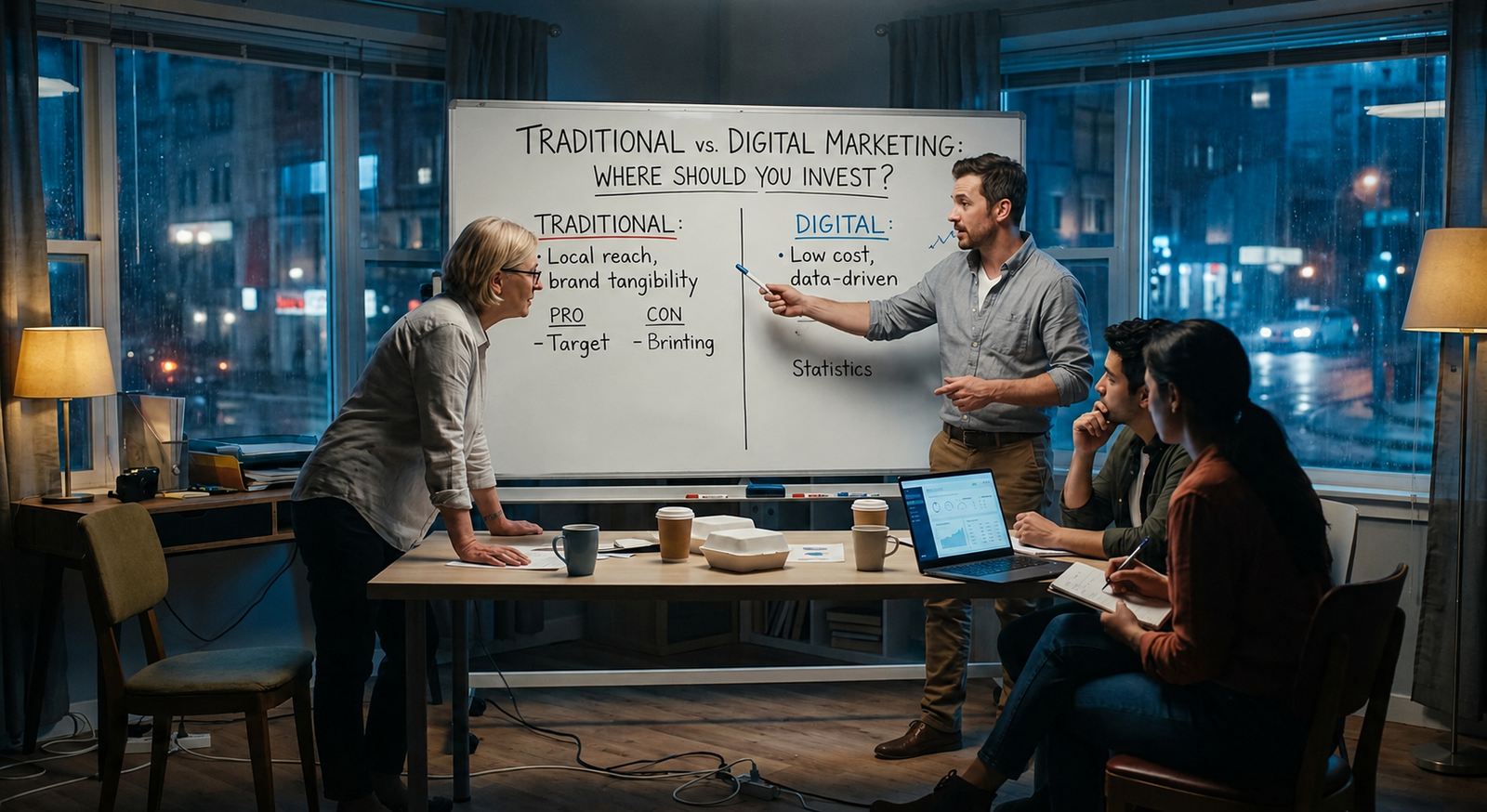
If you are building a startup in 2026, one of the earliest and most consequential decisions you will face is where to put your marketing budget. You probably do not have unlimited resources. Every dollar needs to earn its place. And yet, the debate between traditional marketing and digital marketing continues — not because one is obviously better, but because the right answer genuinely depends on who you are, what you are selling, and where your customers spend their attention. This post is not going to tell you to abandon one for the other. Instead, it is going to help you think clearly about what each approach actually delivers, what the landscape looks like right now in 2026, and how startups in particular should be approaching these choices. What Traditional Marketing Still Gets Right Traditional marketing — billboards, print ads, direct mail, radio, TV spots, event sponsorships — has been declared dead many times over the last decade. It has not died. What it has done is narrow its effective use cases considerably. The strongest argument for traditional marketing is trust. There is a psychological weight to a well-placed print ad in an industry publication or a physical mailer that lands on someone’s desk. It signals investment. It signals permanence. For industries where credibility is paramount — legal, financial services, healthcare, enterprise software — showing up in the physical world still carries a signal that a Facebook ad simply cannot replicate. The second argument is reach in specific demographics. If your customers are over 55, if they live in regions where digital penetration is lower, or if your product is inherently local — a restaurant, a retail shop, a regional service — traditional channels can still be cost-effective and surprisingly direct. The honest limitation, however, is measurement. Traditional marketing has always struggled to prove return on investment with any precision. You run a radio campaign for six weeks and sales go up — did the campaign cause that? You cannot know with confidence. For a startup that needs to know exactly what is working and what is not, that ambiguity is expensive. Why Digital Marketing Has Become the Default Starting Point Digital marketing in 2026 is not what it was even three years ago. The channels have matured, the algorithms have become more sophisticated, and the data available to marketers is richer than ever — even as privacy regulations have tightened in meaningful ways across Europe, North America, and Southeast Asia. For startups, the foundational appeal of digital marketing has always been its precision and its scalability. You can start small, test fast, learn constantly, and scale what works. That remains true, and if anything the tools available today make that cycle faster and more accessible than it has ever been. There are four areas where digital marketing tends to deliver the most consistent value for startups. Search Engine Optimization and Content Marketing remain the single most durable long-term investment a startup can make. When you build content that genuinely answers the questions your customers are asking, you earn organic visibility that compounds over time. Unlike paid advertising, the asset does not disappear the moment you stop spending. A well-optimized article or resource that ranks on the first page of Google is working for you every single day without an ongoing cost-per-click. In 2026, with AI-generated content flooding the internet, the premium on authentic, well-researched, deeply useful content has never been higher. Search engines have become increasingly sophisticated at distinguishing between content that exists to rank and content that exists to genuinely inform — and they reward the latter. Social Media Marketing has evolved into something considerably more nuanced than simply posting regularly and hoping for organic reach. Organic reach on most major platforms has compressed significantly over the past few years. What social media does exceptionally well today is community building, brand storytelling, and serving as a trust-verification layer. When a prospective customer hears about your startup and searches for you on LinkedIn or Instagram, what they find is a direct reflection of your credibility. A coherent, active social presence — one that communicates values, expertise, and personality — does serious conversion work even when it is not the original source of discovery. For startups targeting other businesses, LinkedIn in particular has become a remarkably powerful channel for thought leadership and direct relationship building. Paid Advertising through PPC and Meta platforms is where startups can generate immediate traction while other longer-term channels are being built. Google Search campaigns, Meta’s advertising ecosystem across Facebook and Instagram, and increasingly YouTube and connected TV advertising give startups the ability to put an offer in front of exactly the right person at exactly the right moment. The sophistication of audience targeting has improved considerably. In 2026, performance marketing is no longer just about who you can reach — it is about reaching them in the right context, with the right message, at the right stage of their buying journey. Done well, paid advertising delivers measurable, attributable results within days. Done poorly, it burns budget quickly with little to show for it. The difference almost always comes down to strategy, creative quality, and how rigorously the campaigns are managed and optimized. Email Marketing continues to outperform nearly every other digital channel on a return-on-investment basis, and in 2026 that has not changed. What has changed is the sophistication of what high-performing email programs look like. Simply sending a newsletter to a list is not enough. The startups generating real results from email are the ones building segmented, personalized sequences that meet subscribers where they are in the customer journey — from first awareness through to purchase, onboarding, retention, and referral. As third-party cookies have been deprecated and signal loss has made some paid channels harder to optimize, owned audiences — your email list above all — have become a more strategic asset than ever. Every startup should be building one from day one. The Honest Truth About Where Most Startups Go Wrong Most